
Attic Insulation in Peterborough: How to Tell If Yours Is Failing (And What to Do About It)
Most Peterborough homeowners never think about their attic until something goes wrong. The upstairs bedroom stays cold no matter where you set the thermostat. The gas bill arrives in January and it’s worse than last year. Ice starts building along the edge of the roof, and by March there’s a stain on the ceiling.
Those aren’t four separate problems. They’re one problem showing up four different ways: heat is leaving your house through the attic, and there isn’t enough insulation up there to stop it.
This guide covers how to tell if your attic insulation is failing, what your options actually are, and how to decide between them.
Six Signs Your Attic Insulation Isn’t Doing Its Job
1. Your second floor is a different climate than your first floor. Hot in summer, cold in winter, no matter what the thermostat says. Heat rises. If the attic isn’t sealed and insulated, your second floor is essentially heating the sky.
2. Your heating bill keeps climbing while your habits don’t change. Insulation settles and degrades. If you haven’t touched your attic since you bought the house, it is almost certainly performing worse than the day it was installed.
3. Ice dams form along your eaves. This is the clearest signal there is. Ice dams form when heat escaping into the attic melts the snow on your roof. The meltwater runs down to the eaves — which are cold, because they’re past the heated envelope — and refreezes into a ridge. That ridge traps the next round of meltwater, which backs up under your shingles and into your ceiling. Ice dams are not a roofing problem. They are an insulation and air sealing problem.
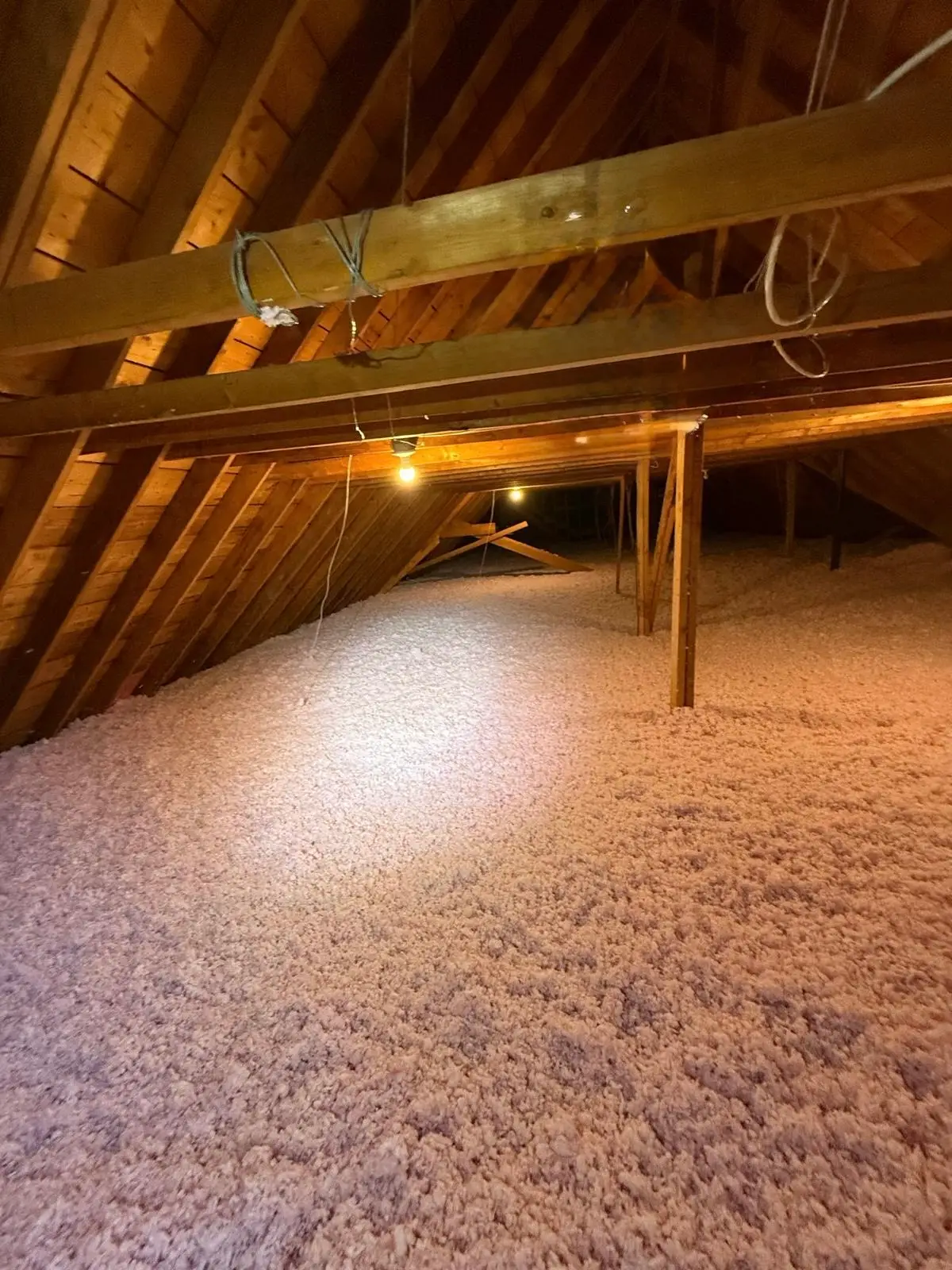
4. You can see your joists. Go up with a flashlight. If the wooden joists are visible above the insulation, you have roughly 6 inches or less up there. That is not enough.
5. Your attic smells, or there’s evidence of animals. Rodent droppings, nesting material, or a musty smell means the insulation is contaminated. Contaminated insulation doesn’t just underperform — it’s a health issue, and it has to come out before anything new goes in.
6. Your house is drafty on windy days. Drafts aren’t only a window problem. Air moves through a house vertically. Air leaking out of the top of your house pulls cold air in at the bottom to replace it. Sealing the attic reduces drafts on the main floor.
Why Peterborough Attics Take a Harder Beating Than Toronto Attics
Peterborough sits further north than the GTA, and Simcoe County winters run longer and colder. More heating days means more hours per year that your attic is the boundary between a 21°C living room and outside air that might be −20°C.
The practical effect: an attic that’s marginally underinsulated in Toronto is meaningfully underinsulated in Peterborough. The same R-value shortfall costs you more, and costs you for more months.
⚠️ VERIFY BEFORE PUBLISHING: The claim that Peterborough has more heating degree days than Toronto is directionally reasonable, but I do not have a verified source for the actual figures. Either confirm against Environment and Climate Change Canada HDD data, or cut the comparison and simply write “Simcoe County winters are long and cold.” The section works either way.
What R-Value Does Your Attic Actually Need?
R-value measures resistance to heat flow. Higher number, better performance. Think of it like the tog rating on a duvet — a 15 keeps you warmer than a 5. Same principle.
Two things homeowners consistently get wrong:
R-values are cumulative. If you have R-20 up there now and it’s clean and dry, we can blow new insulation directly over it. The values add together. You don’t lose what you already paid for.
Compressed insulation loses R-value. Never pack, stuff, or walk on blown-in insulation. If it’s compressed, it isn’t working. This is why storing boxes in the attic quietly costs you money every winter.
For most Ontario attics, the target is R-60 or better. Older homes are frequently sitting well below that — sometimes at R-20 or less, which is roughly a third of what the attic should be doing.
⚠️ VERIFY BEFORE PUBLISHING: (a) Peterborough may fall into a different Ontario Building Code climate zone than the GTA, with different SB-12 requirements. Do not publish “R-60 is the code minimum in Peterborough” until someone confirms Peterborough’s current zone against the live SB-12 tables. The copy above says “R-60 or better” and deliberately avoids the word “code.” Keep it that way until verified. (b) The “older homes sit at R-20 or less” figure comes from your GTA housing stock notes. Extending it to Peterborough’s housing stock is an inference, not a verified fact. Soften to “frequently sitting well below that” if you want zero exposure — that version is already in the draft.
Your Three Real Options
Option 1 — Blown-In Cellulose
Loose-fill insulation made primarily from recycled paper, machine-blown across the attic floor. It’s denser than fibreglass and fills gaps, joist bays, and awkward corners that batts physically cannot reach.
- Roughly R-3.4 to R-3.8 per inch
- Denser, which means it slows air movement through the attic better than fibreglass does
- Made from recycled material — the more environmentally friendly of the two loose-fills
- Best when: you want the most performance per inch of attic depth
Option 2 — Blown-In Fibreglass
Spun glass fibres, installed the same way — blown in with a machine.
- Roughly R-2.7 to R-3.0 per inch
- Lighter than cellulose
- Typically the more cost-effective option, and accepted under current rebate programs
- Best when: budget is the deciding factor and you have the attic depth to hit your target R-value
Cellulose or fibreglass? Cellulose gives you more R-value per inch. Fibreglass usually costs less. Both work. Both are rebate-eligible. The honest answer is that it depends on your attic depth, your budget, and what’s already up there — which is why we look before we quote.
Option 3 — Spray Foam
Spray foam is the premium option. Two components mix at the gun tip and expand on contact, filling and sealing the cavity. The difference isn’t just R-value — foam stops air leakage, where loose-fill only slows heat transfer. We use Insulthane Extreme by Elastochem.
½ lb low-density (open-cell)
- Roughly R-3.5 to R-3.8 per inch
- Lighter, flexible, expands significantly on application
- Best for interior walls, sound dampening, and applications where air sealing is the goal
2 lb high-density (closed-cell)
- Roughly R-6.0 to R-7.0 per inch — the highest of anything we install
- Rigid, and acts as its own vapour Peterboroughr at sufficient thickness
- Best for basements, crawlspaces, rim joists, cold rooms, and garage ceilings
You do not need to leave your home during installation. We don’t use hazardous materials.
The Room Above the Garage
This deserves its own section because it’s the single most common complaint we hear, and almost everyone tries to fix it the wrong way first.
That room is cold because builders typically insulate garage ceilings with fibreglass batt. Batt isn’t airtight, and a garage ceiling is exposed to outdoor air on the underside. Cold air moves right through and into the floor of the room above.
Space heaters don’t fix it. Closing vents doesn’t fix it. Adding more batt doesn’t fix it.
The actual fix is removing the garage ceiling drywall, taking out the existing batt, and spray foaming the cavity with closed-cell foam — then re-drywalling with 5/8″ fire-rated board. It’s a bigger job than people want it to be. It’s also the only thing that works.
What About the Old Insulation? Does It Have to Come Out?
Usually not.
We remove existing insulation only when it’s contaminated — mould, water damage, or rodent activity. If it’s clean and dry, we blow directly over top and the R-values add together.
If it does have to come out, we vacuum it out before installing anything new. Blowing fresh insulation on top of a rodent nest doesn’t hide the problem. It buries it somewhere you can’t see it.
The Part Everyone Skips: Baffles and Ventilation
Here’s the mistake that turns a good insulation job into a moisture problem.
Your attic needs airflow. Air enters at the soffit vents along the eaves and exits at the ridge. That airflow keeps the attic deck cold in winter, which is what prevents ice dams, and keeps moisture from condensing on the underside of the roof.
Blow insulation into an attic without installing baffles, and the loose-fill packs into the eaves and blocks those soffit vents. Now you have a well-insulated attic with no airflow — and within a couple of winters, condensation, mould, and ice dams.
Baffles are inexpensive. They go in before the insulation. Any contractor who doesn’t mention them is telling you something about how they work.
Are There Rebates for Attic Insulation in Peterborough?
Depending on your home and your utility, you may qualify for government rebate programs on insulation work. Program rules, amounts, and eligibility change regularly — so rather than quote you a number that might be out of date, we’ll help you confirm what’s currently available for your specific project.
Ask us when we’re out for the assessment. We handle the paperwork side with you.
⚠️ HARD GATE: No dollar figures on this page. No program names with amounts attached. This section stays generic until Pre-flight E (written verification at homerenovationsavings.ca and nrcan.gc.ca, dated) is in hand. Your own Week 2 plan makes this non-negotiable.
What Attic Insulation Costs in Peterborough
⚠️ SECTION NOT WRITTEN — DELIBERATELY. This is the highest-intent section in the entire post and I will not fabricate the numbers for it. Cost is what people search for and what they scroll to find.
To fill it, pull your last 12–20 Peterborough/Simcoe attic jobs and give me: square footage range, R-value delivered, product used, and final invoice. I’ll write the section as honest ranges tied to home size — e.g. “a typical 1,200 sq ft Peterborough attic topped up to R-60 with blown-in cellulose.”
Frame everything as a range, always caveat with “final price depends on attic size, access, and existing conditions,” and never publish a single fixed number. If you can’t or won’t share job data, cut this section entirely — do not guess.